
Quad Platina Integrated Review: Accuracy and Engagement in Equal Measure
Quad’s Platina series arrived quietly last autumn at a Moscow hi-fi show, debuting with the company’s own electrostatic speakers and making a strong first impression. A proper extended listening session with the Platina Integrated amplifier and Platina Stream network streamer clarifies what the series is and what it is not — and the answer is more interesting than the modest pricing might suggest.
A New Series With Its Own Place
The Platina line sits alongside rather than below Quad’s established Artera range. The series currently comprises three components: the Platina Integrated amplifier with onboard DAC, the Platina Stream network streamer (which also acts as a preamplifier), and the Platina CDT CD transport. Users assembling all three should note that the CD transport feeds the amplifier’s input rather than the streamer’s — the streamer has no suitable digital inputs for it.
Platina Integrated: 200 Watts of Class AB
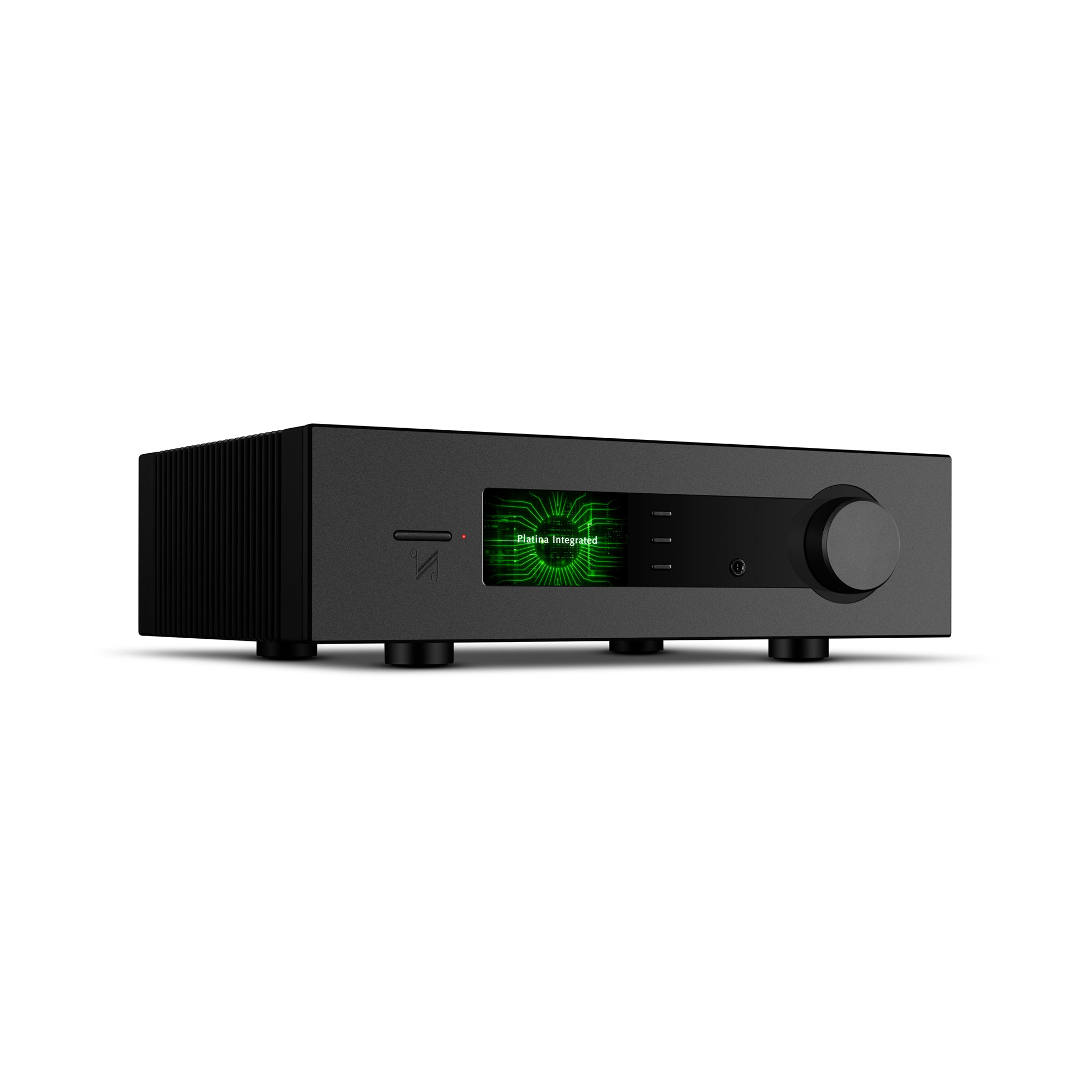
The amplifier is a conventional Class AB design delivering 200 watts per channel into 8 ohms, built around a large toroidal transformer and substantial capacitor bank. Inside, Quad has fitted an ESS Sabre ES9038PRO DAC with dual thermally-stabilised oscillators, covering two optical and two coaxial digital inputs, a USB-C port, and HDMI ARC. A discrete-component MM/MC phono stage rounds out the analogue inputs, with basic gain and loading adjustability. The front panel carries a full-colour display; both balanced and unbalanced analogue outputs are provided.
Platina Stream: The Better DAC
The Platina Stream also uses the ES9038PRO, but the implementation differs from the amplifier’s in two important ways: the power supply architecture is specifically designed to reduce jitter, and the analogue output stages are significantly more elaborate. The practical result is that the streamer’s DAC sounds more open and resolved — even though both share the same chip. The Platina Stream is Roon Ready and connects via Ethernet or Wi-Fi. One honest limitation: the companion app is sparse, cannot control the amplifier’s volume, and offers no DAC filter settings. For a large music library, Roon is the far more comfortable interface.
Sound
The system was tested driving Quad’s own ESL 2812X electrostatic speakers — a demanding and complex load. The combination reveals its character immediately: monitoring accuracy paired with musical engagement. Bass is present and articulate at low volume without bloat; the midrange is open and natural; the treble is resolved without brightness. The stereo image is stable, instruments are correctly spaced and scaled, and nothing in the frequency balance draws attention to itself.
Across a range of material — the Oscar Peterson Trio’s We Get Requests, Chet Baker’s Swimming By Moonlight, Johnny Jewel’s atmospheric The Other Side Of Midnight, Porcupine Tree’s Deadwing, and Mahler’s First Symphony in the Solti/Chicago recording — the Platina pair sustains the same underlying character: truthful timbre, a naturally proportioned soundstage, and the ability to stay engaging without imposing any coloration. The amplifier controls the ESL’s impedance curve with authority; quiet orchestral introductions remain audible and correctly timed even at very low volume levels.
Verdict
The Quad Platina pairing achieves something specific and not especially common: genuinely neutral, monitoring-accurate character that retains musical engagement over extended listening. The companion app is the one clear weakness. For anyone who needs a complete digital-and-analogue integrated solution — particularly with Roon — the Platina Integrated and Stream represent strong value at their respective price points.
| Specification | Platina Integrated | Platina Stream |
|---|---|---|
| Output power | 200 W × 2 (8 Ω) | — |
| DAC | ESS ES9038PRO | ESS ES9038PRO |
| Digital inputs | 2× optical, 2× coaxial, USB-C, HDMI ARC | Network (Ethernet/Wi-Fi), USB |
| Phono input | MM/MC (discrete) | — |
| Streaming | — | Roon Ready |
| Balanced output | Yes | Yes |
| Price | £3,499 | Available separately |


